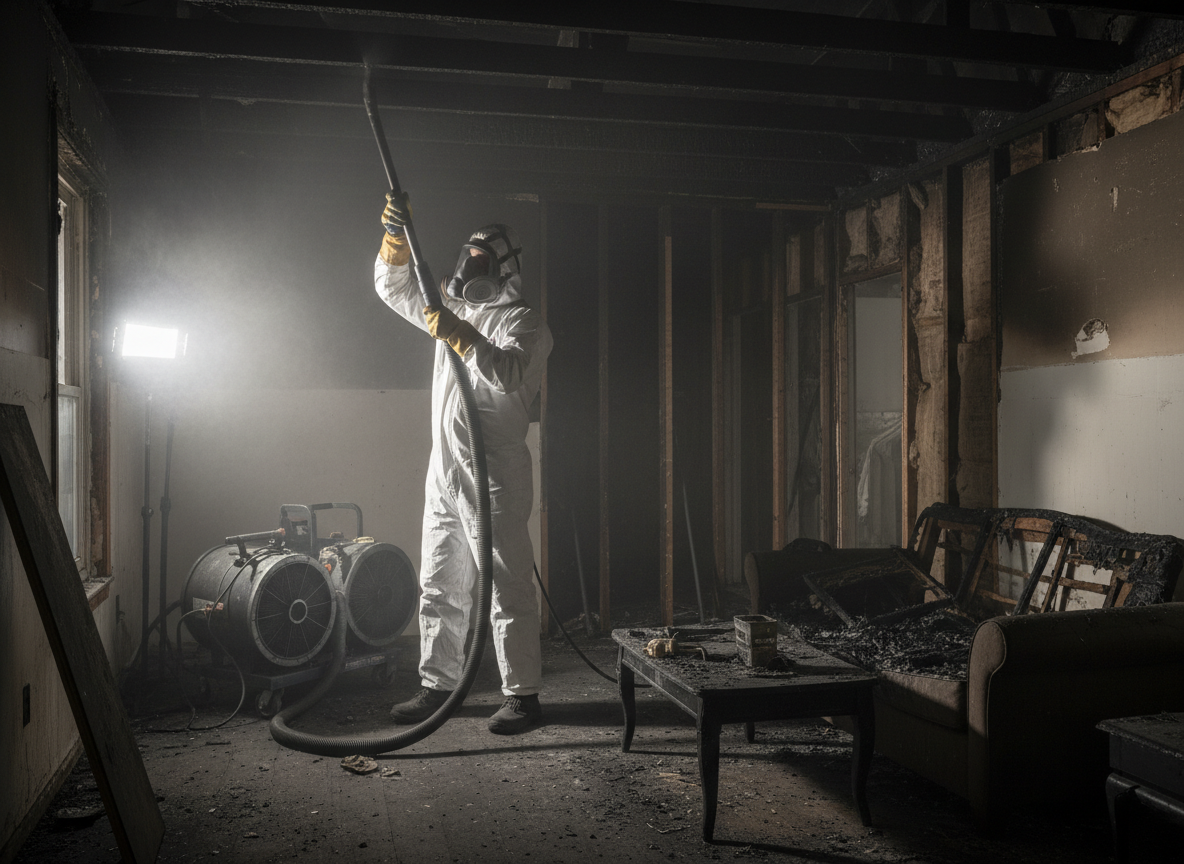
Smoke from structure fires in Patton travels quickly through the older plaster-and-lath walls common around Patton State Hospital and into attics that were never sealed during original construction. Mediterranean summers push temperatures above 100 degrees, which bakes oily residues deeper into drywall, cabinets, and HVAC ductwork before homeowners notice the full extent. Restoration crews must test multiple layers of material because visible soot on surfaces often hides embedded particles that will off-gas again once cooler winter air returns.
Porous materials such as popcorn ceilings and unsealed hardwood floors in San Bernardino County homes absorb alkaline smoke differently than newer construction, requiring pH-neutral cleaners followed by HEPA vacuuming rather than simple wiping. Edge cases include smoke that migrates into electrical boxes and insulation batts near Highland, where removal without disturbing asbestos-containing materials from the 1950s demands extra containment steps. Failure to address these hidden pockets leaves persistent odors that reappear with the first rain.
Code requirements in San Bernardino County call for documented clearance testing after any smoke event that affects more than one room, and insurance carriers now request before-and-after particle counts. Crews document each step because Patton properties near the hospital frequently share walls with neighboring units, allowing smoke to cross property lines and create multi-unit claims that must be handled simultaneously.
Technician insight
In Patton, the thing that catches most people out with Smoke remediation is how the 1950s plaster walls around Patton State Hospital let smoke travel into shared attics and then back down into neighboring units once our hot summers turn to mild winter nights. Homeowners often stop at surface wiping and miss the insulation and ductwork, so the smell returns the first time they run the furnace.
Kitchen fire smoke in a Patton duplex
Smoke from a cooking fire spread through shared attic space into both sides of a 1960s duplex near Highland. Inspection showed heavy soot inside ceiling cavities and HVAC returns on the unaffected side. Crews isolated the attic, cleaned all ducts, and performed clearance testing before residents returned.
How it works
- 1
Initial Assessment
Technicians inspect every affected room, test surfaces for pH levels, and map smoke migration paths through the structure.
- 2
Containment Setup
Negative-air machines and plastic barriers isolate work zones to prevent soot from spreading into unaffected areas of the home.
- 3
Surface Cleaning
HEPA vacuums and specialized detergents remove loose and embedded soot from walls, ceilings, and contents without spreading residue.
- 4
Odor Neutralization
Thermal fogging and hydroxyl generators break down smoke molecules trapped in porous materials and HVAC systems.
- 5
Clearance Testing
Air sampling confirms particle levels meet county standards before barriers are removed and the property is returned to use.
Pricing
Cost depends on square footage affected, number of rooms, and whether HVAC cleaning is required; upfront quotes provided after inspection.